
Criminal Court Cases in Clark County
Clark County criminal case records are divided by court jurisdiction. The Eighth Judicial District Court Portal covers felony and gross-misdemeanor actions once a Justice Court bindover or a grand-jury indictment creates a District Court case. The District Court also keeps criminal appeals, drug-treatment-program matters, writs, and appeals sent to the Nevada Supreme Court. Its clerk is the custodian of the filed case record, not the arresting officer or jail.
Justice Courts handle misdemeanors and the early stages of felony and gross-misdemeanor cases. Municipal Courts keep city ordinance and misdemeanor matters within their own jurisdiction. A case that never leaves one of those courts may not appear in the Clark County District Court portal. The key is to search the court that received the charge, then trace any bindover to its new District Court number.
The court locations page identifies the relevant Clark County courthouse. Its layout also helps distinguish the Regional Justice Center from separate Justice and Municipal Court counters.
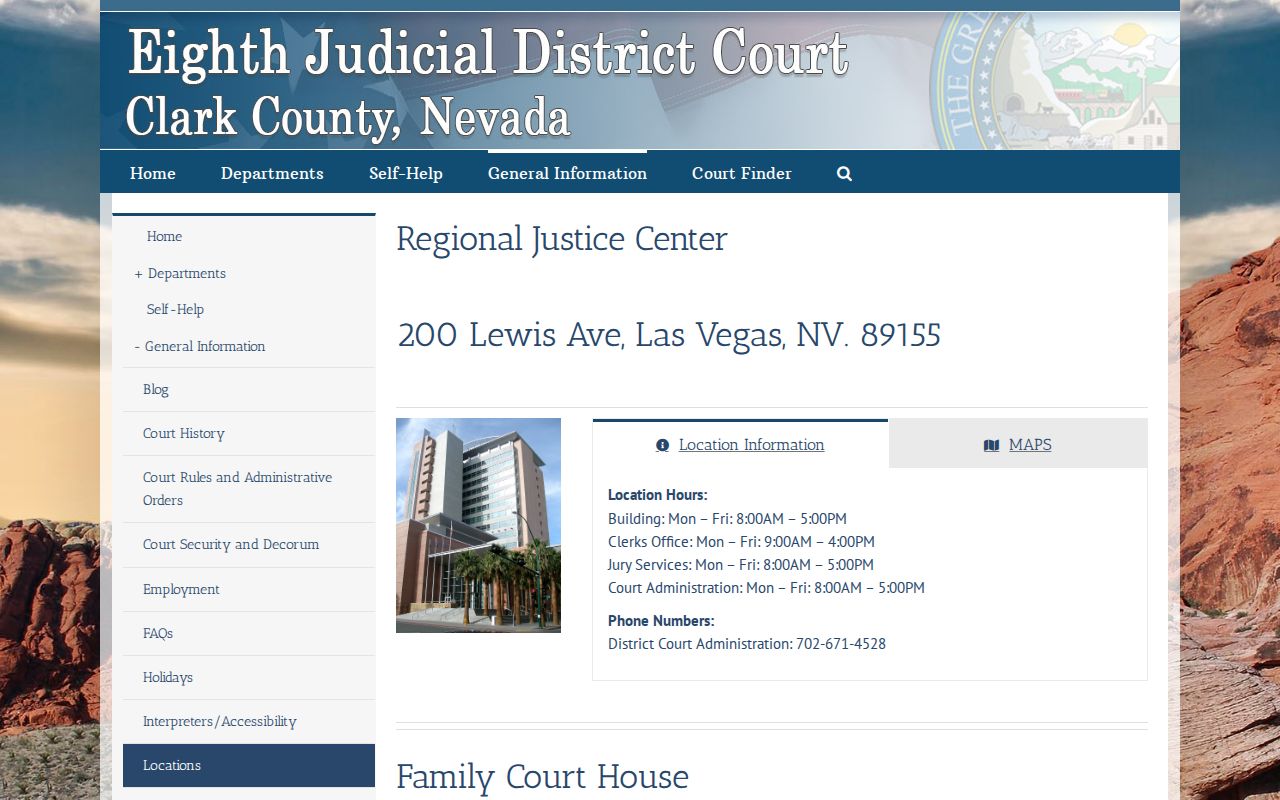
That distinction matters because the wrong clerk cannot supply a file held by another court.
Clark County Criminal Court Routes
A felony accusation often starts in Justice Court, where preliminary proceedings determine whether it moves forward. When the matter is presented for bindover, the Eighth Judicial District Court assigns a District Court case number that day. Scanned documents usually appear after overnight processing. An indictment can also start the District Court file without the same Justice Court route.
City misdemeanors stay with the relevant Municipal Court, while other misdemeanor work may remain in Justice Court. This split explains why one name search can look incomplete. The missing matter may be in another local docket, not absent from Clark County records. For a filed charge, the court docket is the best source for what prosecutors alleged and what the judge later decided. An arrest report answers a different question.
Record flow: Complaint or indictment › originating court › bindover when required › District Court case number › clerk docket and filed documents
Clark County Case Record Searches
Most Clark County District Court records from 1990 forward can be searched without a fee. Use a record number when available. For a party search, the court directs users to enter the name as last name, first name, middle name, and suffix. Wildcards can help, but the official tutorial requires at least three surname characters before an asterisk and one given-name character before an asterisk.
- Open the District Court Portal and choose Smart Search.
- Enter a case or record number, or format the party name as the court directs.
- Use party, business, attorney, judicial-officer, or cross-reference mode when it fits the known identifier.
- Open the case result, then review events, calendar entries, minutes, parties, documents, and status.
- Ask the clerk for a certified copy or a file that the public portal cannot display.
The Clark County Smart Search screen is the direct starting point for District Court index work.
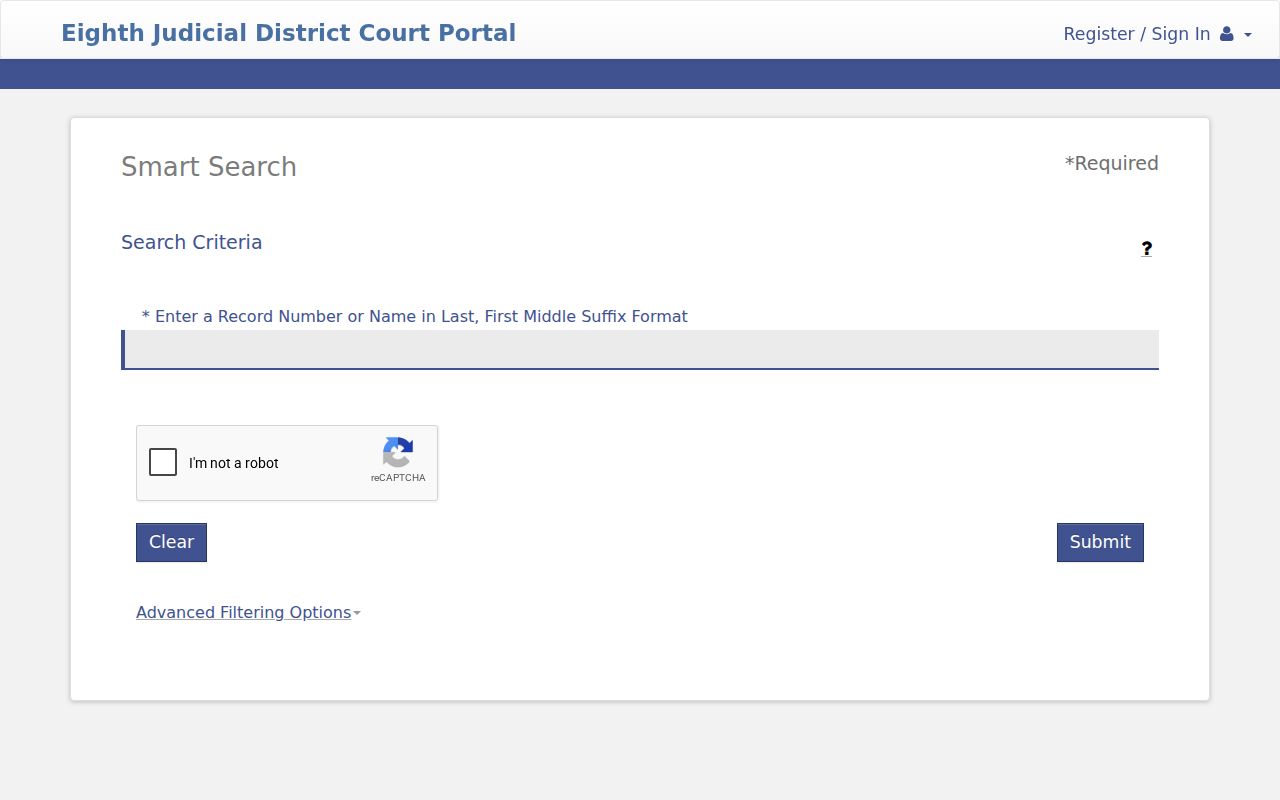
The screen should be read as an index and status view. It does not prove current custody or supply a statewide fingerprint record.
Clark County Smart Search Fields
Smart Search offers more than a basic name box. The required master field accepts a record number or a formatted party name. Advanced search can use a nickname, business, attorney and bar number, case number, judicial officer, or cross-reference. A SCOPE identifier belongs in cross-reference mode. Filters refine a search, but they do not replace a value in the master field.
| Field label | Type | Required | Use |
|---|---|---|---|
| Record Number or Name | Master text | Yes | Case number or Last, First Middle Suffix |
| Last / First Name | Text | In party mode | Wildcard rules apply to each name |
| Search Type | Selection | No | Party, attorney, business, cross-reference, case, or judge |
| DOB From / To | Date | No | Narrows a party search |
| FBI, SO, State ID, Booking | Text | No | Cross-reference identifiers where indexed |
| Case Type, Status, Judge | Selection | No | Options load through JavaScript |
| File Date Start / End | Date | No | Limits the filing period |
The portal requires JavaScript, cookies, and a supported browser. Document purchase also requires account confirmation and an extended-access application. The court says that review typically takes about 48 hours.
The official Smart Search dashboard shows the search interface used for Clark County case records.
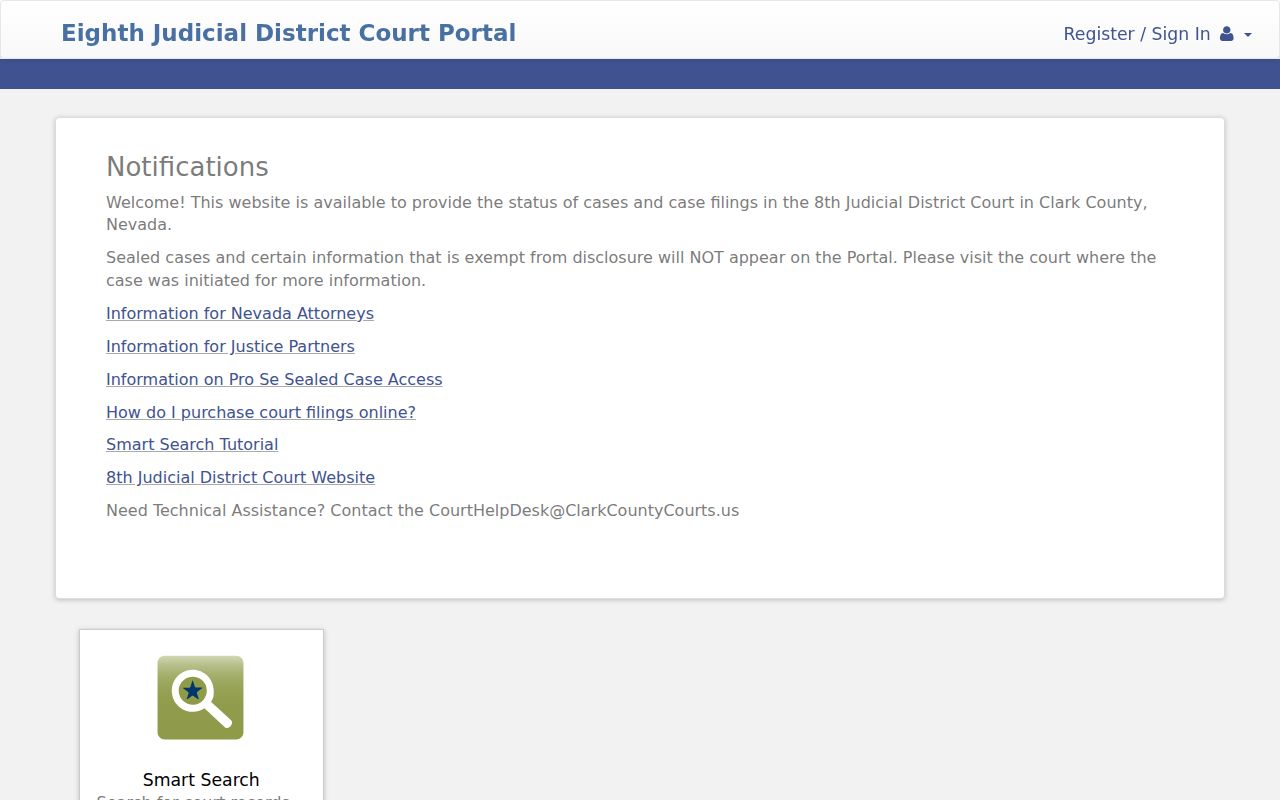
Names, dates, and identifiers should be checked against the clerk file before a reader relies on a match.
What a Criminal Case File Contains
A Clark County criminal case file records what happened after a charge reached the court. It can show the filed accusation, the parties and attorneys, hearings, motions, rulings, pleas, trial events, judgment, and sentence. It may also show financial information. It will not contain an unfiled arrest merely because a police report or jail booking exists elsewhere.
| Case number and court | The file identifier, case type, location, status, and judicial officer. |
|---|---|
| Charging document | The complaint, information, or indictment that states the filed counts. |
| Parties and counsel | Party roles and attorneys when indexed. |
| Docket and minutes | Filed events, hearing entries, minutes indicators, and court activity. |
| Documents | Description, date, page count, preview, and access status when available. |
| Outcome and sentence | Dismissal, acquittal, conviction, judgment, sentence, or other formal result. |
A disposition is the formal outcome. An acquittal means not guilty, while a dismissal ends a count without conviction. An information is a prosecutor's accusation; an indictment is a grand jury's accusation. Those terms describe court events, not guilt on their own.
Clark County Court Copy Options
Online documents cost $0.50 per page plus a 3 percent convenience fee after registration. The portal can show a first-page preview, page count, and subtotal where access is allowed. Free public electronic viewing is available at the clerk counter, but certified and exemplified copies are not sold through the online purchase tool.
Send a copy request to recordsrequest@clarkcountycourts.us or mail it to Clerk of Court, Attn: Records, 200 East Lewis Avenue, Las Vegas, NV 89155. Give the case number, or the complete party name and filing year. Standard copy and search requests are described as taking about five to ten business days. Large or off-site requests may take two weeks. Certification adds $3 per document; exemplification adds $6. A customer-supplied copy costs $5 to certify or $9 to exemplify.
The Nevada judiciary's court record request guide explains why judicial records follow court rules rather than a simple executive-agency request process.
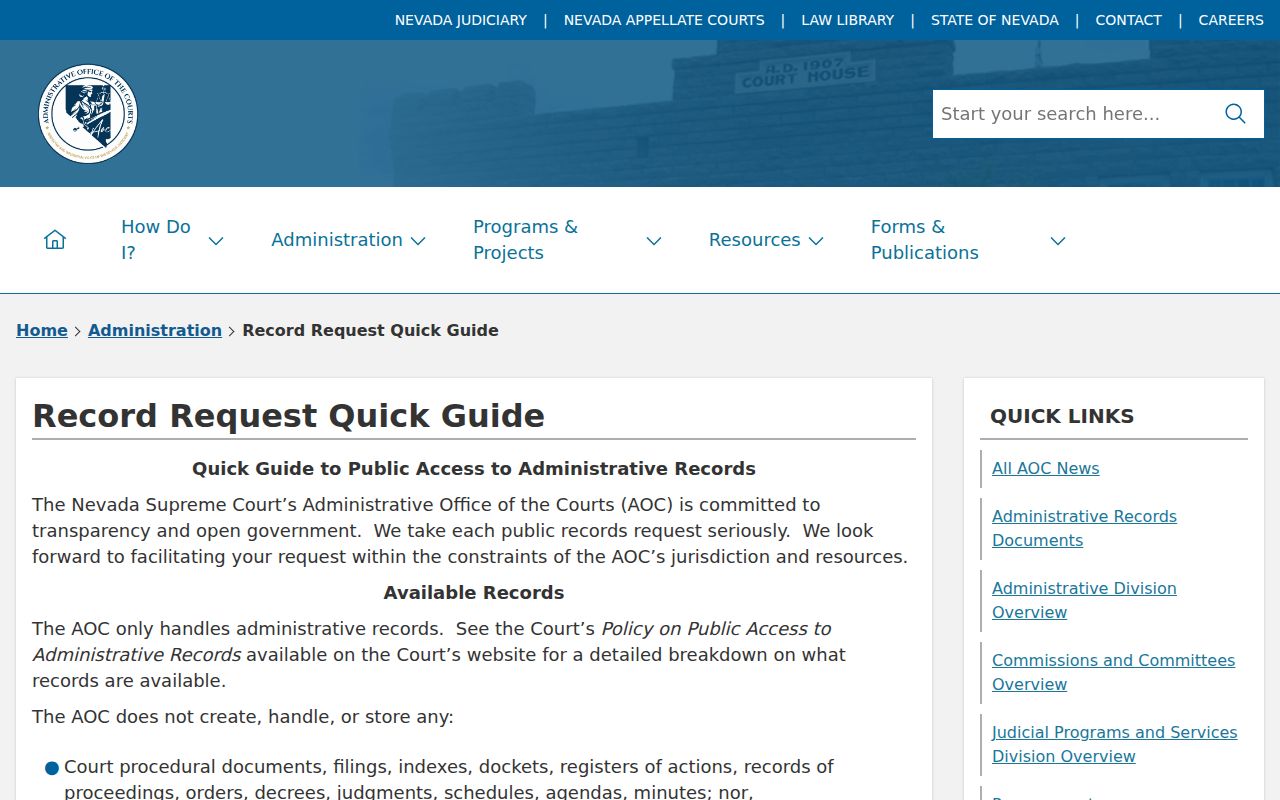
Use the clerk's own request channel when a certified result or an official file is needed.
Criminal Case Stages in Clark County
The filed case begins when the prosecutor brings a complaint, information, or indictment to the proper court. Arraignment records the accused person's response to the charge. Pretrial work may add motions, hearings, negotiations, and amended counts. A plea can resolve the case; otherwise, the matter can move to trial. The court then enters the disposition and, after a conviction, the sentence.
Case flow: Charges Filed › Arraignment › Pretrial › Plea or Trial › Disposition › Sentencing
New filing details may lag up to nine workdays, although judgments normally post within one business day. The calendar's “Yes” link can open minutes. Event code “260” may combine hearings held on the same date, so it should not be read as a charge or outcome code.
Clark County Court Docket Terms
Docket shorthand can change the meaning of a search result. Read the entry beside its date and document, then confirm the final disposition. Clark County case records may show several counts with different results, and the outcome of one count should not be applied to the rest.
- Plea
- The accused person's formal response to a filed charge.
- Disposition
- The court's formal result for a case or count.
- Capias
- A court order commanding that a person be taken into custody.
- Concurrent sentence
- Terms served during the same span of time.
- Consecutive sentence
- Terms served one after another.
The Nevada Supreme Court maintains a separate appellate case search, while the Court of Appeals portal covers that court's work.
An appeal uses a new appellate docket and does not replace the trial court's Clark County record.
Missing Clark County Court Cases
A blank portal result is not proof that no Clark County criminal case exists. Records before 1990 may require clerk research, and the clerk holds files back to September 1909. Earlier Clark-area records may be held with Lincoln County. Staff can check the microfilm index when the Odyssey system does not return an old file. Pre-1990 research costs $0.50 per year per name.
Present custody belongs in CCDC or NDOC, while the arrest narrative belongs with the investigating agency. A statewide fingerprint history comes from RCCD through a subject's own DPS-006 request. If the question concerns booking rather than the filed court case, the Clark County arrest search explains the custody and report channels.
Active trial cases can be locked online until trial ends. A sealed portion can also hide an entire multi-defendant matter because the technology cannot suppress only one party or selected documents. Unsealed evidence is viewed by appointment with government photo ID. Sealed access for a party or counsel must be handled in person, and public release needs court authority.
Access Rules for Case Records
Nevada court files do not follow the same access rule as executive-branch records. The Nevada Judiciary states that NRS Chapter 239 does not govern judicial records. Court policies and the originating court's rules control judicial administrative and case access. NRS Chapter 179A separately controls criminal-history dissemination. That is why the clerk, rather than a broad county public-records desk, is the right source for a Clark County criminal court file.
Sealed matters and information made confidential by law do not appear in the public portal. Victim, juvenile, and other protected data may be removed from a view or document. Filing details can also be delayed. The official record is the clerk's file, not an interpreted search result or screen capture. Hearing video and JAVS requests follow a separate process through the Regional Justice Center.
The Nevada Court of Appeals portal illustrates the separate appellate layer.
Trial and appellate records should be read together when an appeal may have changed the result.