
Clark County Criminal History Checks
No one search produces a complete Clark County criminal history. Start with the Eighth Judicial District Court Portal when the question concerns a felony or gross-misdemeanor case. Use the court that first handled a misdemeanor or preliminary hearing if the district search has no match. The Clark County Detention Center, or CCDC, answers a different question: whether a person is in current or recent county custody. The arresting agency holds its own report. The Nevada Department of Public Safety repository provides a subject-only, fingerprint-supported Nevada history.
Names can vary, so gather a full legal name, date of birth, old names, and any known case, booking, SCOPE, State ID, or FBI number. Then move through the official sources without treating one missing result as proof of no record.
- Choose the custodian based on whether you need a court result, custody status, police narrative, or your own statewide history.
- Search the proper portal using the narrowest reliable name or identifier.
- Compare dates, court locations, and case or booking numbers before linking records.
- Request the underlying file from the clerk, jail, or arresting police agency.
- Ask for a certified copy or fingerprint check when an official document is required.
Clark County’s official service directory is a useful starting point. The captured county page below illustrates that government routing layer.

That directory points outward because the county itself is not the custodian for every police, detention, and court record.
Clark County Criminal Records Portal
The District Court’s Smart Search covers most district matters from 1990 forward. Enter a record number or a party as last name, first name, middle name, and suffix. Party mode permits a surname wildcard after at least three letters and a first-name wildcard after at least one. Advanced paths include business, attorney, case number, judicial officer, and cross-reference. A SCOPE identifier belongs in that cross-reference route.
| Search control | Best use | Limit |
|---|---|---|
| Record number or name | Primary Clark County criminal case search | A master value is required |
| Party and nickname | Name variations | Broad wildcards can be slow |
| Cross-reference | SCOPE, SID, FBI, SO, or booking number | Works only when indexed |
| File dates and status | Narrow a result set | Filters do not replace the master value |
New filing detail can lag by up to nine workdays, while judgments normally post within one business day. The clerk’s file remains the official source.
Official Background Checks in Nevada
The Nevada Department of Public Safety, Records, Communications and Compliance Division keeps the Central Repository. It does not offer a general public name search for another person’s statewide rap sheet. The official repository self-review FAQ explains the subject-only scope. Its DPS-006 form is for the subject’s own fingerprint-matched Nevada record, chiefly covering repository transactions from 1987 forward. The request costs $27 and requires an original FD-258 fingerprint card. A mailed packet uses a money order or certified check, not cash or a personal check. Nevada residents may also begin at the electronic records-request hub.
Clark County residents can obtain LiveScan-to-card service from LVMPD. The first card costs $20 and an added card costs $2 under the July 2026 schedule. That service prints the card; it does not transmit it to the repository. The state’s fingerprint-card explanation describes how arrest prints flow to the repository. The FBI’s separate Identity History Summary costs $18 and may contain fingerprint submissions from more than one jurisdiction.
The Nevada RCCD homepage identifies the state repository and its record-review routes. Its captured page provides a visual reference for the agency responsible for Nevada criminal history.
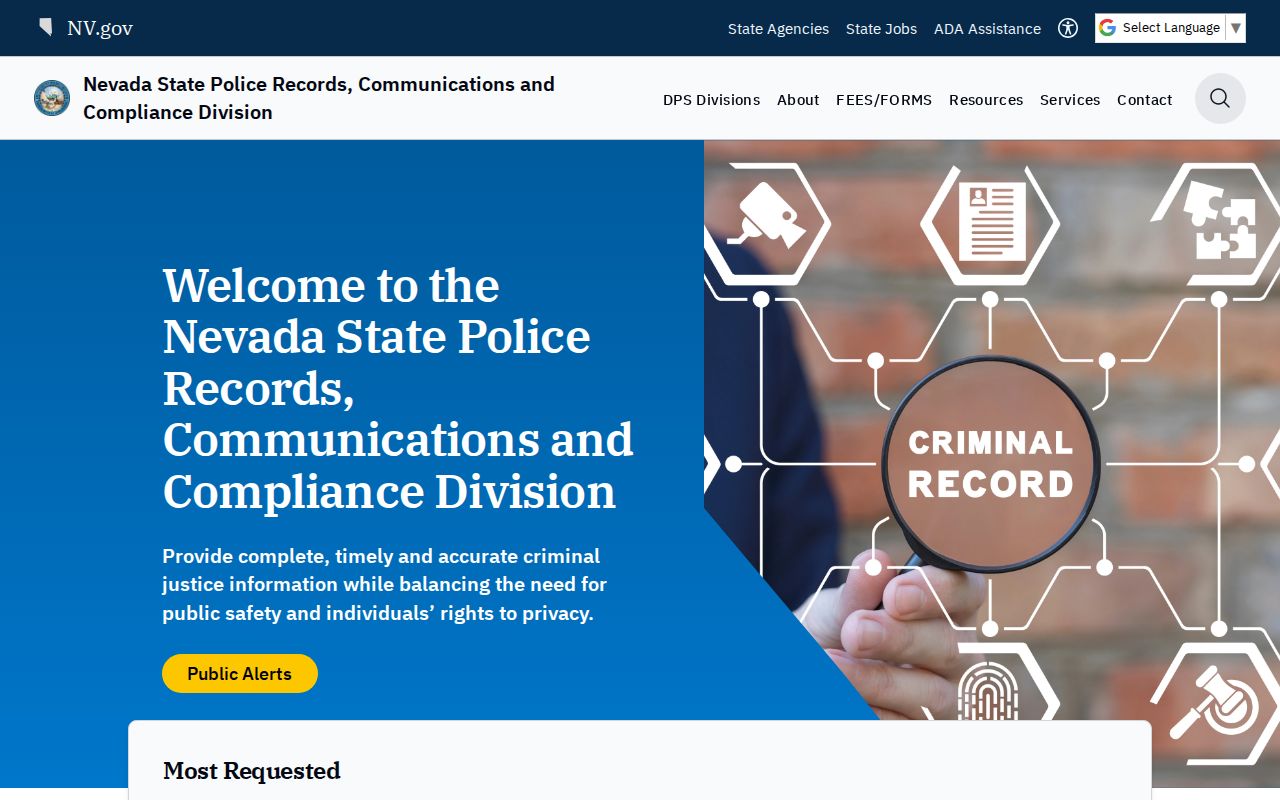
Use that official channel for self-review rather than treating a local court or SCOPE result as a statewide record.
Clark County SCOPE Versus DPS
An LVMPD SCOPE is local. It can document releasable LVMPD contacts and arrests, but it is not a Nevada or FBI history. DPS-006 is statewide and fingerprint-linked, yet it is Nevada-only and subject-only. A court docket is narrower still because it shows a filed case, its events, and its outcome. These products can differ without any office being wrong.
| Channel | What it answers | Access |
|---|---|---|
| LVMPD SCOPE | Local LVMPD history permitted for release | Verified local request |
| DPS-006 | Your Nevada fingerprint-supported history | Subject only, $27 plus fingerprints |
| District Portal | Filed district cases and docket events | Free search; copies may cost |
| FBI Summary | Your FBI-maintained multi-state history | Subject fingerprint request, $18 |
Choose by scope, not convenience. If a Nevada entry looks wrong, review it through RCCD and the agency that first recorded the information.
Kinds of Criminal Records
Nevada law distinguishes a criminal-history record from an incident report, court index, and booking profile. An officer’s report can describe an allegation and evidence without proving that a prosecutor filed a charge. A booking entry records a custody event. The court file tracks the formal accusation, hearings, plea, disposition, and sentence. Repository history connects fingerprint-supported Nevada arrest cycles with reported outcomes.
- Police reports come from LVMPD or the city, school, university, state, tribal, or federal agency that wrote them.
- Bookings come from CCDC or a separate city detention facility.
- Court files belong to the District, Justice, or Municipal Court clerk with jurisdiction.
- Warrants remain tied to the issuing court and law-enforcement systems.
- State history comes through the fingerprint-based Central Repository self-review route.
The official Clark County records-routing page makes the custodian split explicit. The image below shows why a request must go to the office that owns the record.
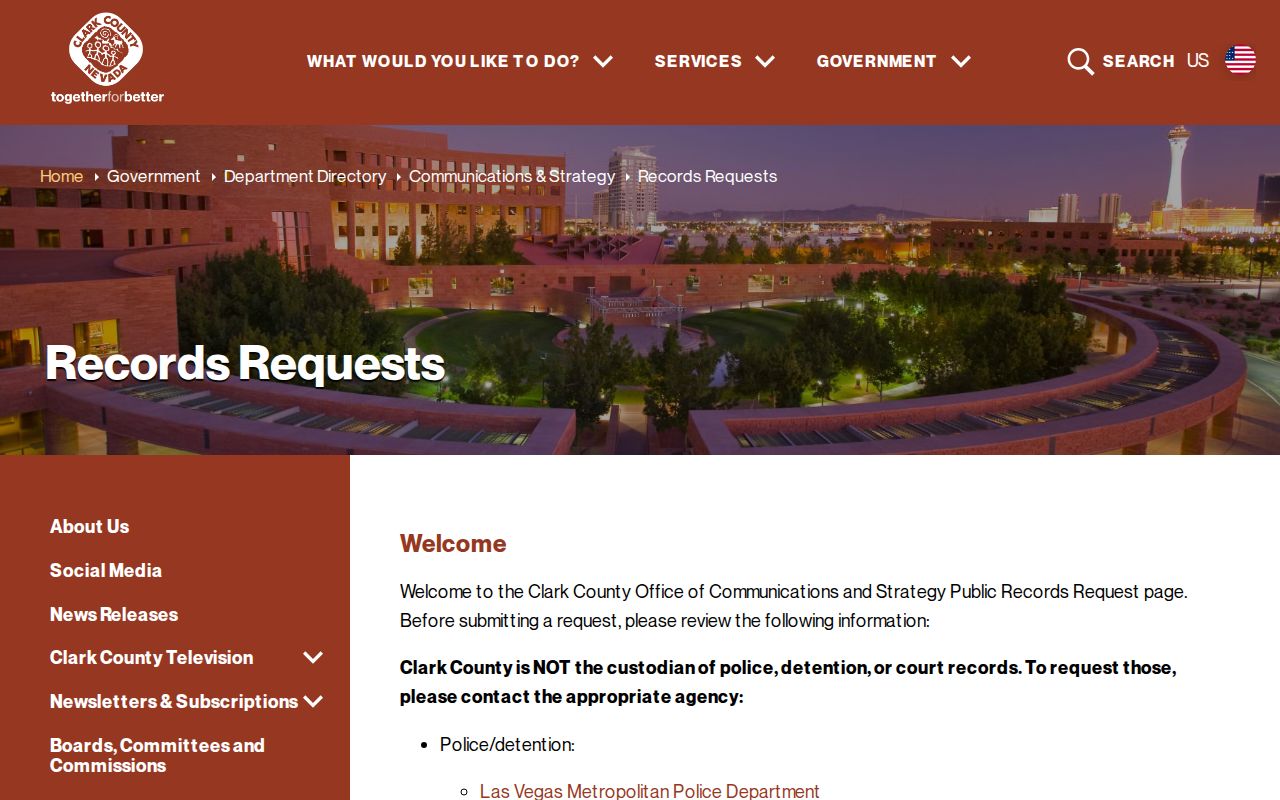
Sending an LVMPD report request to the county clerk, for example, will not produce the police narrative.
Clark County Booking Record Routes
CCDC is the main custody channel for many LVMPD and county arrests, but Clark County does not have one jail route for all events. Henderson maintains a separate detention search. Las Vegas city custody, North Las Vegas custody, Laughlin holding, juvenile detention, and some contract arrangements can lead elsewhere. Start with the arrest location and agency.
The CCDC search accepts only one field at a time: last name, inmate ID, or Justice Court case number. A last name needs at least two letters. People under 18 and those in protective custody are not displayed. After release, a live row may vanish even though the agency report or later court case remains. If the person was transferred to state prison, use the Nevada Department of Corrections Offender Search. VINE supplies confidential custody notifications.
Flow: Arresting agency → booking facility → prosecutor → court clerk → reported disposition → Nevada Central Repository.
Note: A missing CCDC result describes that live roster’s coverage, not the absence of Clark County arrest records.
Clark County Criminal Records: What They Contain
A record’s fields reveal which stage it represents. Police reports use event numbers, dates, locations, involved people, and a releasable narrative. Booking data can add an inmate identifier, facility, intake date, initial charge, detainer, bail, and scheduled action. Court files identify parties, case type, filing date, judicial officer, docket events, documents, disposition, and sentence. A Nevada rap sheet ties identifying data and fingerprints to repository arrest cycles and reported outcomes.
| Name and identifiers | Legal name, aliases where reported, DOB, SCOPE, SID, FBI, SO, booking, or case number. |
|---|---|
| Arrest and booking | Event, arrest and booking dates, facility, initial allegations, custody, bail, and detainers. |
| Charges and statutes | Counts alleged at booking or formally filed, which may not match. |
| Disposition | Dismissal, acquittal, conviction, or other formal resolution. |
| Sentence | Custody, supervision, fines, restitution, or other court orders. |
| Custody or supervision | Jail, prison, probation, parole, release, or registration data within the source’s scope. |
Do not merge fields from unrelated people or systems. Confirm a final outcome with the clerk.
Clark County Record Identifiers Explained
Clark County systems use several keys. SCOPE is associated with LVMPD’s local record. SID identifies a state repository subject. An FBI number connects federal fingerprint submissions. A booking number or inmate ID points to a custody event, while a court case number identifies a judicial file. Smart Search may accept some identifiers through its cross-reference mode.
- Disposition
- The court’s formal outcome for a charge.
- Information
- A prosecutor’s formal accusation filed in court.
- Capias
- A court command directing that a person be taken into custody.
- Recognizance
- A release based on a promise to appear without secured bail.
- Sealing
- Nevada’s process for restricting a record without destroying it.
One identifier cannot answer every question. Use it in the system that created or indexed it.
Nevada Public Access Laws
The Nevada Public Records Act generally presumes executive and local government records open unless another rule makes material confidential. Under NRS 239.0107, an office must respond by the end of the fifth business day with access, a supported denial, or a written estimate. That deadline is for the response, not guaranteed production. Criminal-history dissemination has separate limits, and judicial records follow court rules rather than a simple Chapter 239 assumption.
Key Nevada laws:
NRS 239.010 states the public-record presumption and its exceptions.
NRS 239.0107 sets the five-business-day response choices.
NRS 179A.100 controls dissemination of criminal history.
NRS 179A.150 gives a subject an inspection and correction route.
NRS 179.240 to 179.301 governs record sealing.
Juvenile, victim, investigative, sealed, and other protected material may be withheld or redacted.
Older Clark County Criminal Case Files
The District Clerk holds records from September 1909. Most files from 1990 forward are searchable online, while earlier matters may require a clerk request and a microfilm index. Pre-1990 research costs $0.50 per year per name. Copies cost $0.50 per page, certification adds $3 per document, and exemplification adds $6. A customer-provided copy costs $5 to certify or $9 to exemplify.
Send the case number, or full party names and filing year, to the Clerk’s records unit. Ordinary searches are described as five to ten business days; large or off-site work can take two weeks. Evidence viewing is by appointment with current government photo identification. For events before Clark County formed in 1909, records may point back to Lincoln County.
Note: An online gap can reflect age, sealing, an active-trial lock, or court jurisdiction rather than no Clark County criminal case.
Restricted, Sealed & Expunged Records
Nevada ordinarily seals criminal records; it does not use expungement as its standard remedy. Sealing restricts a record in covered systems but does not destroy it, and a Nevada order cannot promise that an out-of-state agency will act the same way. Waiting periods vary by offense and run from release from custody or discharge from supervision, whichever is later. Some child and sexual offenses cannot be sealed.
Clark County’s process begins with a current verified Nevada criminal history. The petitioner prepares the petition, affidavit, and proposed order. The District Attorney reviews qualifying District Court and Clark Justice Court matters, but municipal cases go to the relevant city attorney and municipal court. After a signed order is filed, copies must reach each listed agency. RCCD estimates two to four months to process a correct order.
The Clark County District Attorney sealing hub provides current forms and routing. Its captured instructions show the local path.
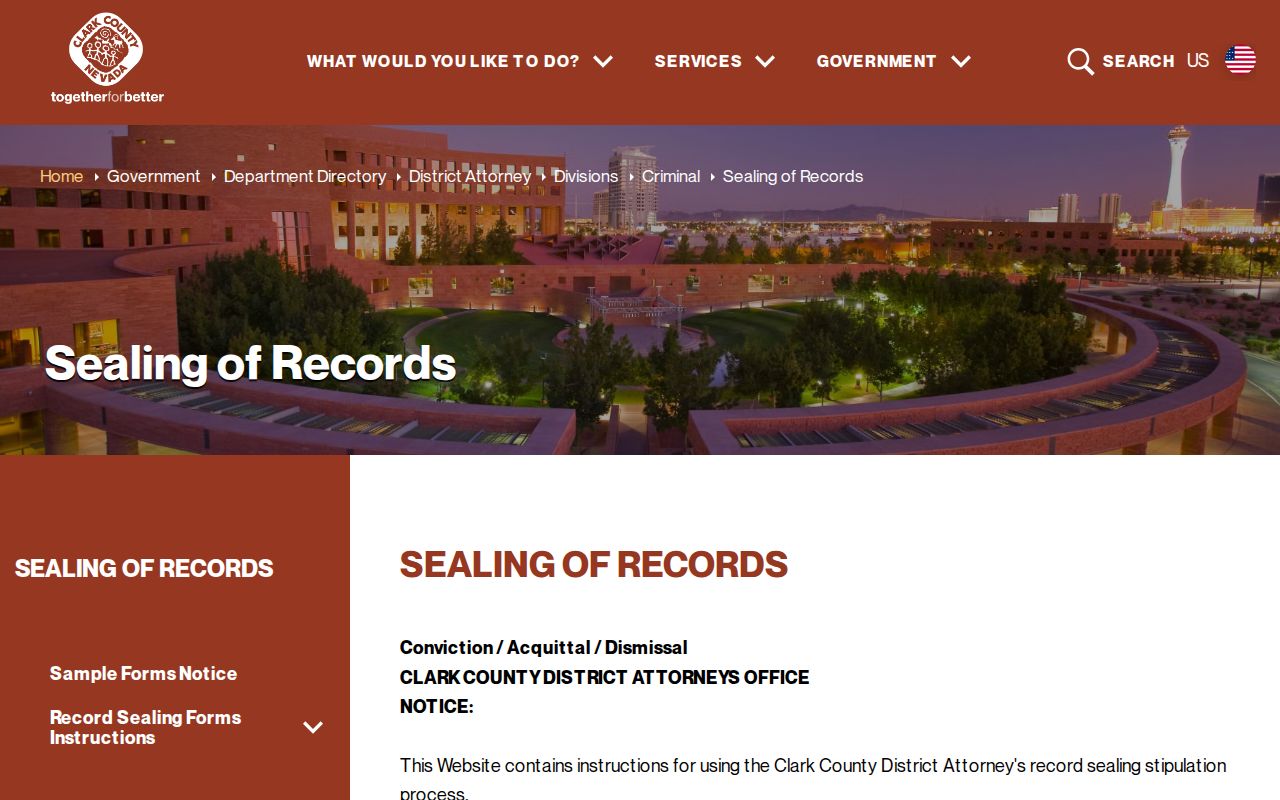
The DA’s Record Sealing Coordinator accepts eligible submissions at the Regional Justice Center, Room 3305.
Clark County Warrant Record Checks
No complete countywide warrant database exists. Check every plausible issuing court, including District, Las Vegas Justice and Municipal, Henderson Justice and Municipal, and North Las Vegas Justice and Municipal Courts. A portal event can offer a lead, but sealed warrants or indictments will not appear. The clerk should confirm warrant status, bail, surrender, or payment instructions.
LVMPD cannot verify identity by phone and warns that a wanted visitor at its records counter may prompt officer notification. Its Wanted Fugitives page is a selected quarterly list, not a comprehensive search. Once a warrant is executed, check the correct jail. For a releasable police narrative, use the arresting agency’s report channel. LVMPD separates involved-party reports, Public Records Unit requests, and Communications Research requests for CAD, 911, or radio audio.
District Court Clerk
200 East Lewis Avenue, Las Vegas, NV 89155
702-455-2590
Counter: weekdays, 9 a.m. to 4 p.m.
LVMPD Records
400 S. Martin L. King Blvd., Building C, Las Vegas, NV 89106
702-828-3111
Weekdays 7 a.m. to 6 p.m.; weekends 8 a.m. to 5 p.m.
Clark County Criminal Justice Context
Jurisdiction is unusually important in a county built around tourism and unincorporated communities. Many properties called “Las Vegas” sit in Paradise or another unincorporated area. That can make LVMPD, CCDC, and Las Vegas Justice Court more relevant than Las Vegas Municipal Court. Physical distance does not settle custody either. The Regional Justice Center, detention center, police records campus, and public defense offices are close, but each office keeps a different file.
Clark County’s 2024 estimated population was 2,398,871. It spans 7,891.65 square miles, and one third of residents age five or older speak a language other than English at home. Those facts help explain the number of city, county, and state record routes. A 2022 local justice snapshot reported that more than 84 percent of CCDC’s population had a felony as the highest charge.
The Clark County Criminal Justice Coordinating Council library publishes plans and data on diversion, jail population, specialty courts, and data alignment. The captured library page provides local system context.
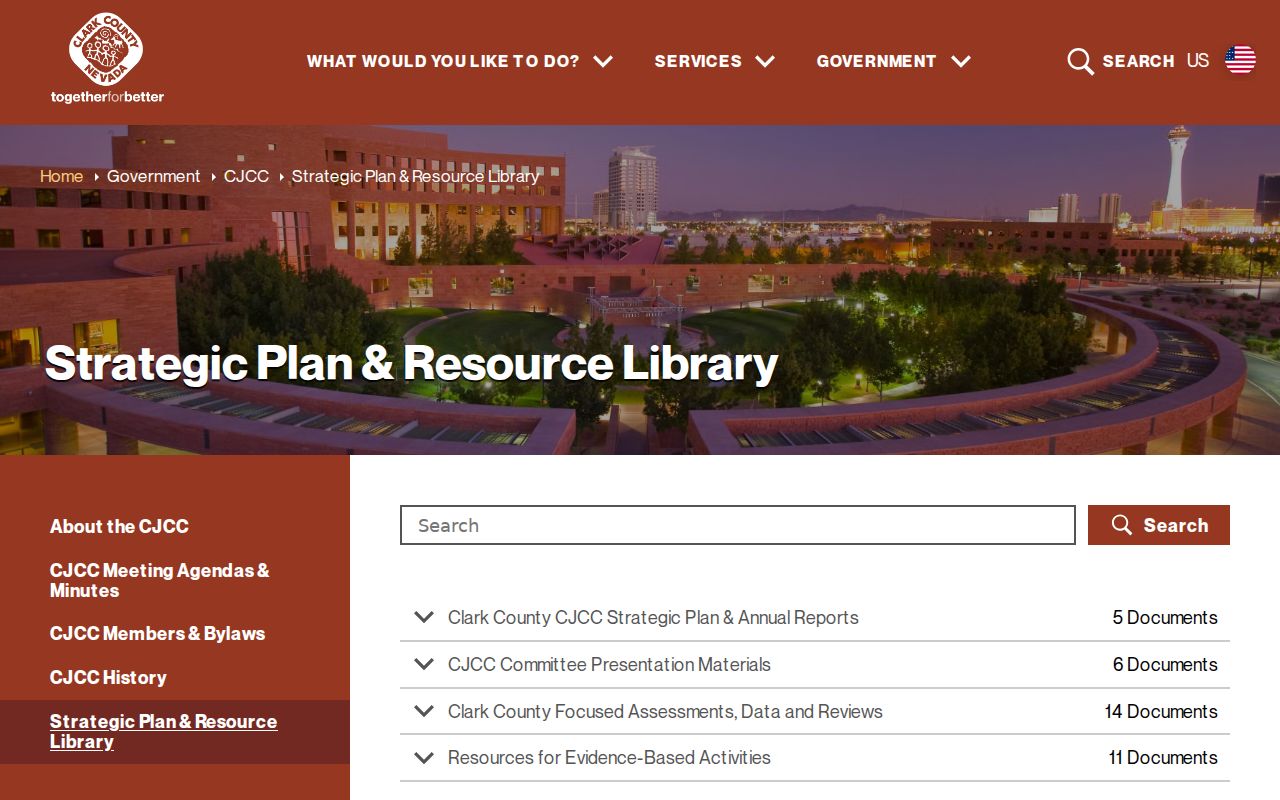
Those projects show why records may move among police, detention, prosecutors, courts, and state repositories over time.
City-by-City Criminal Records in Clark County
City records add local police reports, municipal cases, fees, and custody paths. Las Vegas relies on LVMPD and its Municipal Court, while much of the Strip remains outside city limits. Henderson has its own police records unit, municipal eAccess system, and detention lookup. North Las Vegas keeps a separate police records counter and municipal docket, with felony preliminaries routed through its Justice Court.
Las Vegas Record Check
678,922 residents · LVMPD and Las Vegas Municipal Court channels.
Henderson Record Check
350,039 residents · city police, eAccess, and separate detention search.
North Las Vegas Record Check
294,034 residents · NLVPD, Municipal Court, and Justice Court routes.
The Census city estimate chart supports the three-city order. The captured chart records the official population comparison used here.
Start at city level only when the police agency or municipal court actually handled the event.